City guide

Bali

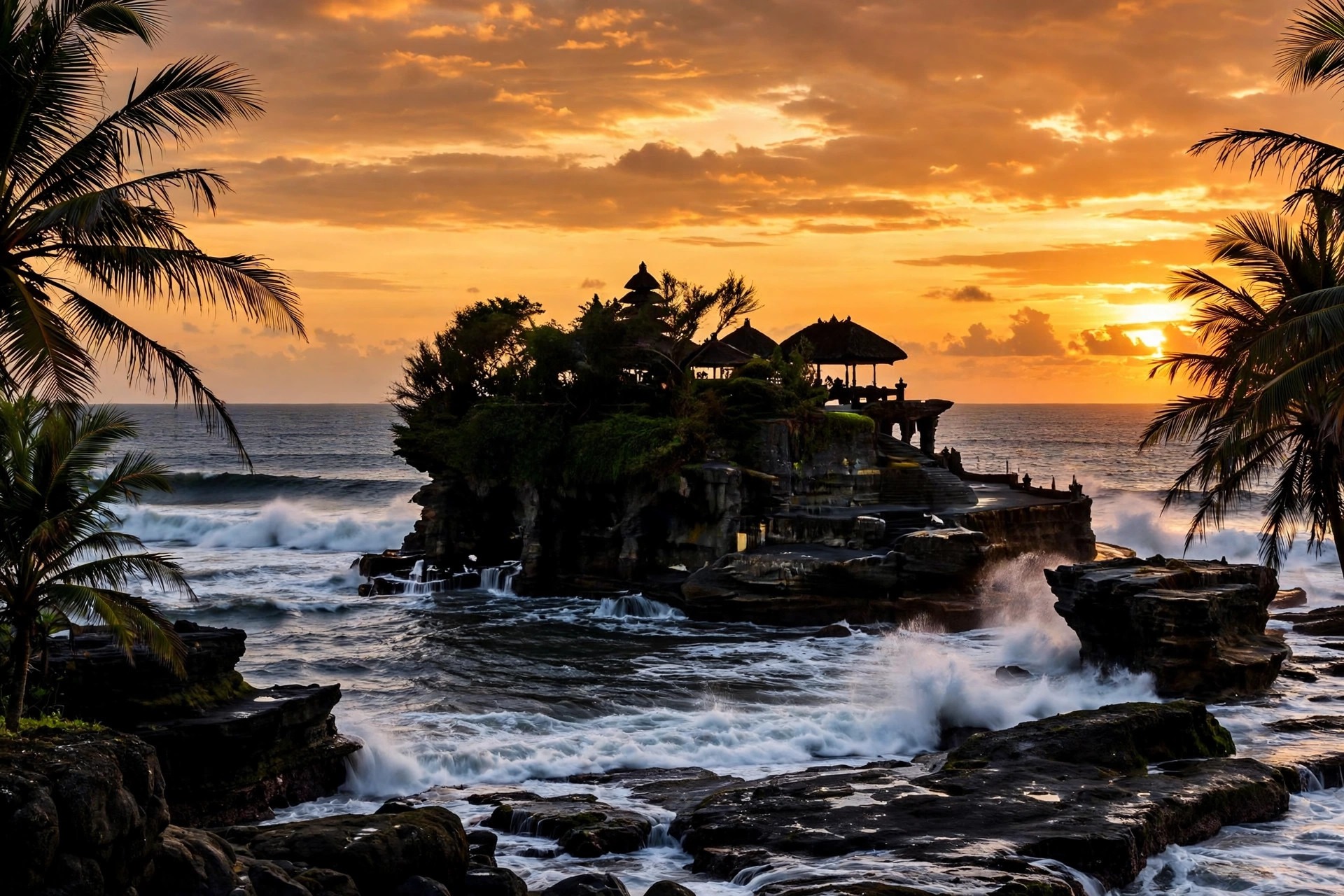
Tanah Lot temple at sunset, the shrine on its sea rock with waves breaking around it
Photo: AI-generated for XingAI Travel

First time in Bali?

Bali is an island of temples and terraces — sea temples on cliff edges and lake shores, rice terraces stepping up the hillsides, and the ocean on every side. About 6.9 million foreign visitors came in 2025, a record, and most of them come for the same first choice the island asks you to make: the mountains first, or the sea first. It is warm all year, 27 to 32 degrees, and the difference between the seasons is rain, not heat — the dry season runs April to October, and May, June and September are the sweet spot, dry without the July–August crowds. Five to seven days take in Ubud, the south coast and one long temple-and-terrace loop. Foreign visitors also pay a one-time tourist levy of IDR 150,000 per trip. Our take, our own judgment with no ranking cited: safety 7/10 (violent crime against visitors is rare; the real risks are everyday ones — scooter crashes, rip currents at Kuta, Seminyak and Canggu, and bag-snatching and scams in the busy strips — hire a driver instead of riding a scooter, swim only between the flags at a lifeguarded beach, and use Grab, Gojek or Bluebird and change money at a bank or an authorised changer), happiness 8/10 (temples, terraces, beaches, food and spa culture on one island; the July–August crowds and the traffic between the south coast and Ubud cost it a point), cost 9/10 (a warung plate of nasi campur is IDR 25,000–50,000 and a full day of food, rides and a temple or two runs about IDR 280,000–450,000 — the cheapest of our cities so far; villas and beach clubs are the only real splurges).

Not listed here: opening hours, prices, closures and events. They change, so check them before you go.

Practical info

Best season
May, June and September — the dry season without the July–August peak. The dry season runs April to October; the wet season (November to March) brings short, heavy afternoon downpours, not whole days lost. Check the date of Nyepi, the island-wide day of silence, before you book: the airport closes and nobody leaves their hotel.
Suggested days
5 days for Ubud, the south coast and one temple-and-terrace loop; 7 days to add Nusa Penida by fast boat and one slow day.
Our take
First-time Asia, temple and beach lovers, and anyone travelling on a small budget; skip the scooter unless you are licensed and experienced — hire a driver — and do not try to fit Lempuyang and the north loop into the same day.

Our own judgment, based on what's on this page — no ranking cited.

Places worth knowing

20 places across 10 areas. Every fact links to its source.

Sacred Monkey Forest SanctuaryMandala Suci Wenara Wana

Ubud

  • Nature
  • Iconic
  • Culture

A working temple forest in the middle of Ubud — more than 700 long-tailed macaques, century-old banyans, and three temples under the canopy. Foreign adults pay IDR 130,000 and entry is cashless; keep your bag zipped and your glasses and phone out of reach, because the monkeys take what they can grab.

Outdoors · Best in the morning · 60–120 min (estimate)

Ubud PalacePuri Saren Agung

Ubud

  • Culture
  • Iconic
  • Photo spots

The royal palace at Ubud's crossroads — carved gates, a stone guardian row, and a courtyard that still hosts the royal family. Come in the evening, when the courtyard fills for a traditional dance performance under the lights.

Outdoors · Best in the evening · 30–60 min (estimate)

1 source
Open in maps

Goa Gajah (Elephant Cave)Goa Gajah

Ubud

  • Culture
  • Iconic

A 9th-century cave temple east of Ubud — a demon-mouth doorway carved into the rock face, a bathing pool with stone spouts, and a quiet jungle garden behind it. One of the island's oldest sacred sites, and a short drive from the town centre.

Indoors & outdoors · Best in the morning · 45–90 min (estimate)

1 source
Open in maps

Tegallalang Rice TerraceTegalalang

Tegallalang & Tampaksiring

  • Iconic
  • Photo spots
  • Nature

The postcard rice terraces north of Ubud — green steps falling down a valley, irrigation channels older than the roads, and farmers still working the paddies. Entry is about IDR 25,000 at the main gate, with swings and nests inside charged separately; come in the morning, when the light is soft and the day-trippers have not arrived.

Outdoors · Best in the morning · 60–120 min (estimate)

1 source
Open in maps

Tirta Empul TemplePura Tirta Empul

Tegallalang & Tampaksiring

  • Culture
  • Iconic

The holy spring temple of Tampaksiring — a thousand-year-old bathing place where Balinese Hindus purify themselves under thirteen stone spouts. Foreign adults pay IDR 75,000, sarong included; visitors may join the ritual, or watch from the edge of the pools.

Outdoors · Best in the morning · 45–90 min (estimate)

1 source
Open in maps

Jatiluwih Rice TerracesJatiluwih

Jatiluwih

  • Iconic
  • Nature
  • Photo spots

The wide-open rice terraces of the central highlands — a UNESCO-listed cultural landscape, far larger and quieter than Tegallalang, with the subak irrigation system still run by the farming villages. Walk the ridge paths between the paddies; the scale, not the crowds, is the point.

Outdoors · Best in the morning · 60–120 min (estimate)

1 source
Open in maps

Ulun Danu Beratan TemplePura Ulun Danu Beratan

Bedugul & Lake Beratan

  • Iconic
  • Culture
  • Photo spots

The water temple on Lake Beratan — tiered shrines standing at the water's edge, mist over the lake in the morning, and the cool air of the highlands at 1,200 metres. Foreign adults pay IDR 100,000; come early, before the mist lifts and the tour buses arrive.

Outdoors · Best in the morning · 60–120 min (estimate)

Tanah Lot TemplePura Tanah Lot

Tanah Lot

  • Iconic
  • Culture
  • Photo spots

The sea temple on a rock off the west coast — a 16th-century shrine that stands in the surf at high tide and can be walked to at low tide. Foreign adults pay IDR 75,000. Sunset is the hour everyone comes for, so arrive an hour early and watch the rock turn black against the sky.

Outdoors · Best at sunset · 60–120 min (estimate)

1 source
Open in maps

Uluwatu TemplePura Luhur Uluwatu

The Bukit Peninsula

  • Iconic
  • Culture
  • Photo spots

The clifftop temple at Bali's southern tip — a 10th-century shrine on a 70-metre cliff over the Indian Ocean, with grey macaques working the grounds. Entry is about IDR 50,000–60,000; the sunset Kecak fire dance is a separate IDR 150,000, starts around 18:00, and sells out — book ahead. Hold your glasses and phone tight: the monkeys here are professionals.

Outdoors · Best at sunset · 90–150 min (estimate)

1 source
Open in maps

Lempuyang Temple (Gates of Heaven)Pura Lempuyang Luhur

East Bali

  • Iconic
  • Culture
  • Photo spots

The Gates of Heaven — a split stone gate framing Mount Agung, one of the most photographed views in Bali and one of the island's six holiest temples. A shuttle from the lower car park is mandatory, and the photo queue runs two to four hours after 8:00; arrive at 5:15 and the wait is under thirty minutes, before Agung clouds over around 10:00. The climb to the summit temple is 1,700 steps; most visitors never go past the first gate.

Outdoors · Best in the morning · 120–240 min (estimate)

3 ways to experience Bali

None of them is “the best”. Each one gives up something to get something else.

Ubud First

The classic first day inland: the ridge walk in the cool morning, the monkey forest, and the palace and the lotus temple as the evening comes on.

Why this route

  • • It answers the island's first question — mountains first — in one day, on foot.
  • • The order matters: the ridge is only good before the heat, and the palace is only alive in the evening.

Good for

  • First-time visitors
  • Walkers — one day entirely on foot
  • Temple and garden lovers

Trade-offs

  • • Lempuyang is not on this route — the photo queue alone is two to four hours, and it needs its own dawn start.
  • • The monkey forest is busiest at midday — the ridge first is what keeps this day calm.
  • • No beach on this day — the sea is the second day's answer.

Adjust this route

Simple rules over the places on this page. Nothing is generated, and every change says why.

Map

Indian OceanUbud1234

Schematic map, not for navigation. Use “Open in maps” for directions.

Stop by stop

All times are estimates.

  1. About 1 h 30 min hereOpen in mapsApproximate point for the area
    About this place (sourced)

    A grassy ridge walk on Ubud's western edge — a paved path over rolling green hills, palm valleys on both sides, and almost no buildings in sight. Come at sunrise or late afternoon, when the light is low and the heat has not arrived; the full out-and-back takes one to two hours and costs nothing.

    1 source
  2. About 35 min by walking

    About 1 h 30 min hereOpen in maps
    About this place (sourced)

    A working temple forest in the middle of Ubud — more than 700 long-tailed macaques, century-old banyans, and three temples under the canopy. Foreign adults pay IDR 130,000 and entry is cashless; keep your bag zipped and your glasses and phone out of reach, because the monkeys take what they can grab.

  3. About 20 min by walking

    About 45 min hereOpen in maps
    About this place (sourced)

    The royal palace at Ubud's crossroads — carved gates, a stone guardian row, and a courtyard that still hosts the royal family. Come in the evening, when the courtyard fills for a traditional dance performance under the lights.

    1 source
  4. About 5 min by walking

    About 30 min hereOpen in maps
    About this place (sourced)

    A water temple behind a lotus pond, a two-minute walk from the palace — carved stone, frangipani, and pink lotuses across the water. Free to enter; wear a sarong, as at every temple. Best in the morning, before the pond crowds arrive.

    1 source

How Bali compares

Want your own best match?

This page shows places and day routes. To decide whether Bali fits you — against alternatives — add your origin, dates, budget, and what matters.

Build my Bali decision

What this page does not cover

We only list facts that stay true. These change too often to show without a live source:

  • Opening hours and closing days
  • Ticket prices and fees
  • Events, festivals and temporary closures
  • Live transit, weather and crowds